You have cleaned the counters, sealed the cracks you could find, switched to airtight food containers, and sprayed every trail that appeared. The ants disappeared for a few days—and then came back. A different room, a different entry point, the same problem. If you have been through this cycle in your Encinitas home, the frustration is understandable. But the difficulty is not about what you are doing wrong. It is about the specific ant species that dominates coastal Southern California and why it is uniquely resistant to the methods most homeowners use. Here is why ants in Encinitas are so persistent and what actually works against them.
The Species Makes the Difference
The ant behind nearly every kitchen trail in Encinitas is the Argentine ant—and Argentine ants are fundamentally different from the ant species that homeowners in other parts of the country deal with.
Most ant species form individual colonies with a single queen. Kill the queen and the colony collapses. The colonies compete with each other for territory, which naturally limits population density in any given area.
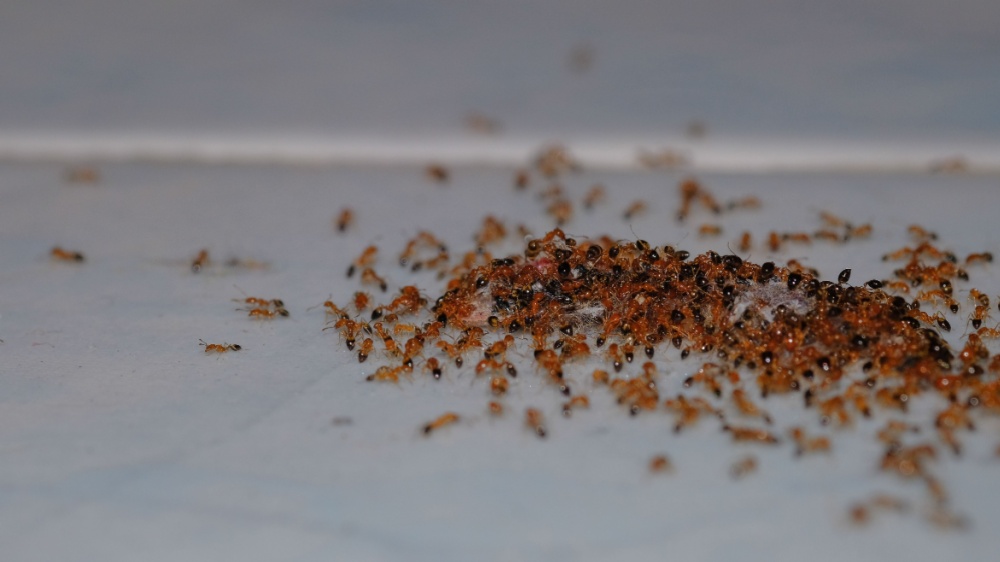
Argentine ants do not work that way. They form supercolonies—vast, interconnected networks of nests with multiple queens that cooperate rather than compete. A single super colony can span your entire neighborhood. The colony under your driveway is connected to the colony in your neighbor’s planting bed, which is connected to the colony in the next yard, and so on. The population is not thousands—it is millions, spread across a continuous network with no territorial boundaries between nesting sites.
This super colony structure is why Argentine ants are so hard to eliminate. You are not fighting a single colony with a single queen. You are fighting a decentralized network with dozens or hundreds of queens across multiple properties.
Why Consumer Sprays Make It Worse
Most consumer ant sprays contain pyrethroid-based active ingredients that repel insects. When Argentine ants encounter the repellent residue on a treated surface, they do not walk through it and die. They detect it, avoid it, and redirect their foraging to a different route.
That redirection is the best-case scenario. The worst scenario—and one that happens frequently—is colony fragmentation. When a portion of the supercolony encounters a repellent chemical, workers and queens from that section may separate from the main network and establish a new, independent nesting site elsewhere. The homeowner sprayed one trail and now has ant activity from two or three new locations.
This is not a failure of application technique. It is a fundamental mismatch between the product’s mechanism (repel) and the species’ biology (multi-queen super colonies that reproduce by budding). Consumer repellent sprays are designed for single-queen species. They make Argentine ant problems worse.
Why Encinitas’s Climate Amplifies the Problem
Argentine ants are persistent everywhere they are established in Southern California. In Encinitas specifically, the coastal climate amplifies the challenge:
- No winter reduction: The mild year-round temperatures mean Argentine ant super colonies never go dormant. They are active and foraging in every month. In colder climates, winter provides a natural reduction in ant pressure. Encinitas does not get that break.
- Constant moisture near the coast: The marine layer maintains soil moisture levels near coastal foundations that support dense ant nesting activity year-round. The colonies that are pressuring your home are nesting in soil that never dries out enough to stress them.
- Irrigation sustains nesting habitat: Every irrigated lawn and planting bed in Encinitas creates moist soil conditions adjacent to the foundation—exactly where Argentine ants prefer to nest. The water you put on your landscaping is sustaining the colonies that send foragers into your home.
What Actually Works
Eliminating Argentine ants in Encinitas requires two things that consumer products cannot provide:
- Non-repellent colony-transfer products: These professional-grade treatments are undetectable to ants. Foragers walk through the treated zone, pick up the product on their bodies, and carry it back to the nest. Inside the colony, the product spreads through the population via contact and food sharing. Over one to three weeks, it reaches the queens. The colony network collapses from within—not because you killed the workers on the counter, but because those workers delivered the product to the source.
- Sustained, recurring service: A single treatment can eliminate the colonies currently pressuring your home. But the super colony network extends beyond your property, and new foragers from neighboring nesting sites will eventually discover your foundation. Bi-monthly service maintains the barrier that intercepts those new foragers before they establish new trails inside your home. It is the recurring maintenance that turns a temporary fix into lasting protection.
If ants have been impossible to eliminate in your Encinitas home, contact Kennedy Pest Control for a free inspection and find out what colony-level treatment can do that spraying never will.