
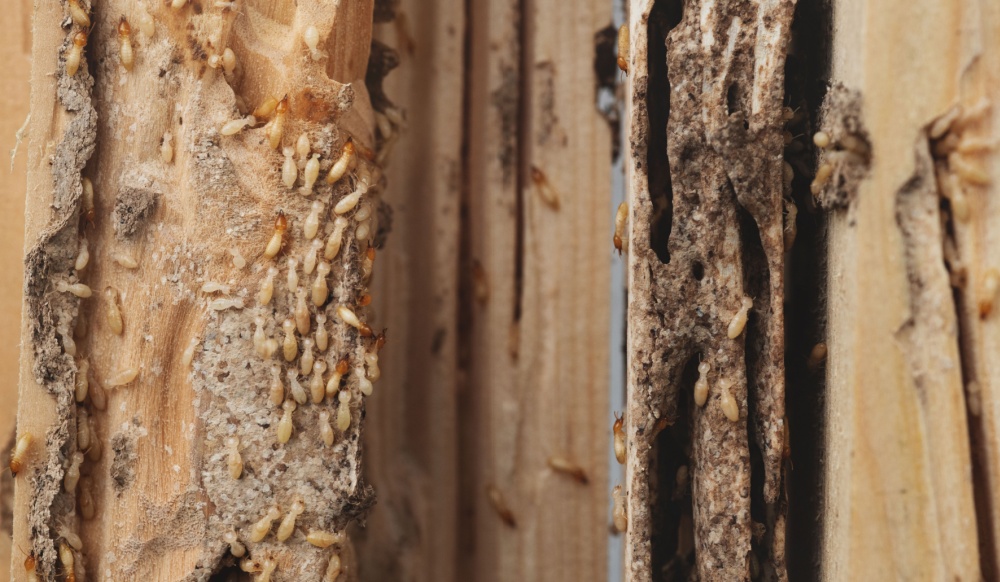
Termites are one of the few pests that can cause significant structural damage to a home before the homeowner even knows they are present. In Carlsbad, where both drywood and subterranean termites are active year-round in the mild coastal climate, the risk is not hypothetical—it is a routine part of homeownership. Knowing what to look for gives you the best chance of catching an infestation early, when treatment is simpler and less expensive. Here is how to identify termite activity in your Carlsbad home.
Drywood Termite Signs
Drywood termites are the more common species in coastal Carlsbad homes. They infest wood directly from the air—no soil contact required—and build their colonies entirely inside the wood they feed on. Because they live inside the wood, they are difficult to detect until the colony has been established for some time.
Frass (droppings). This is the most reliable early indicator of drywood termite activity. Drywood termites push their fecal pellets out of the colony through small openings in the wood surface called kick-out holes. The pellets are hard, roughly the size of a grain of sand, and have a distinctive elongated shape with six concave sides—though this detail is difficult to see without magnification. They range in color from light tan to dark brown depending on the type of wood being consumed.
Where to look: on windowsills beneath window frames, on floors or surfaces beneath exterior trim, on shelving inside closets, on the floor of the attic near rafters, and on any horizontal surface beneath exposed wood.
If you find small piles of what look like fine sand or sawdust on a windowsill, shelf, or floor—and the pile reappears after you clean it up – drywood termites are the most likely cause.
Kick-out holes. These are the tiny openings (roughly 1 to 2 millimeters in diameter) through which termites expel frass. They are difficult to spot on rough or painted wood but are visible on smooth surfaces when you know what to look for.
Swarmer activity. Drywood termites produce winged reproductives (swarmers) that emerge from mature colonies, typically in September and October in San Diego County—though swarming can occur at other times. Finding small, winged insects near windows, on windowsills, or around exterior lights in the evening is a strong indicator that a mature drywood termite colony is present in or near the home. Shed wings—small, translucent, roughly equal-sized pairs—found on windowsills or in light fixtures are another sign.
Hollow or damaged wood. Tapping on wood that sounds hollow or papery may indicate that termites have consumed the interior, leaving only a thin outer shell. Blistering or darkened areas on wood surfaces can also indicate subsurface gallery activity.
Subterranean Termite Signs
Subterranean termites live in the soil and access wood through mud tubes—pencil-width tunnels made of soil, saliva, and fecal material that bridge the gap between the ground and the wood surface.
- Mud tubes: The most visible sign of subterranean termite activity. Look for thin, brownish tubes running up the exterior or interior of foundation walls, along plumbing penetrations, on piers in crawl spaces, and on any surface that connects the soil to the structure. Mud tubes may also appear inside garages on the walls near the floor.
- Soft or water-damaged-looking wood near the foundation: Subterranean termites consume wood along the grain, often leaving a layered, honeycombed pattern. Wood near the soil line that appears water-damaged but has no moisture source may be termite-damaged.
- Swarmer activity in spring: Subterranean termites in San Diego County typically swarm in late winter through spring. Finding small, winged insects emerging from the soil near the foundation, from cracks in concrete, or inside the home near baseboards and windows may indicate a subterranean colony.
What to Do If You Find Signs
Do not attempt to treat termites with consumer products. Consumer sprays do not reach the colony inside the wood (drywood) or in the soil (subterranean), and they do not provide the scope of treatment needed for elimination.
The appropriate steps are:
- Note what you found and where—take photos if possible
- Do not disturb the area—knocking on suspected termite-damaged wood or breaking open mud tubes makes inspection more difficult
- Schedule a professional termite inspection
If you have found signs that suggest termite activity—or if your Carlsbad home has not been inspected recently—contact Kennedy Pest Control for a free termite inspection.


